Microspikes vs Crampons vs Snowshoes: Winter Traction Guide
As an Amazon Associate, PeakTrail Hub earns from qualifying purchases. Our recommendations are based on published manufacturer specifications and buyer review patterns, not hands-on testing.
Venturing into winter backcountry environments requires far more than just warm clothing and insulated boots. As soon as trail snow undergoes freeze-thaw cycles, packed snow turns into solid blue ice, wind creates bulletproof alpine crust, and fresh blizzards leave waist-deep powder drifts. Carrying the wrong traction device on a frozen mountain pass is one of the most common causes of backcountry search-and-rescue calls in North America. Using slip-on microspikes on steep alpine ice can lead to catastrophic slips, while wearing bulky snowshoes on narrow, hard-packed trails wastes immense physical stamina.
Selecting between microspikes, trail crampons, mountaineering crampons, and snowshoes comes down to three physical variables: surface hardness, slope angle, and snow depth.
The quick answer:
- Hard-packed snow, rolling icy paths, and forest day hikes: Kahtoola MICROspikes. Built with twelve 3/8-inch heat-treated 400-series stainless steel spikes connected by flexible welded chains and a tear-resistant elastomer band pliable to -22°F (-30°C).
- Steep frozen mountain trails with crusty snow and off-camber terrain: Hillsound Trail Crampon. Features aggressive 2/3-inch carbon steel spikes mounted on ergonomic hinged steel plates, secured by an over-the-instep velcro retention strap.
- Glacier travel, hard alpine ice, and mountain ascents over 25 degrees: Black Diamond Contact Strap Crampons. Engineered with ten tempered stainless steel points, universal flexible strap bindings that fit non-welted hiking boots, and dual-density ABS anti-balling plates.
- Deep untracked powder snow and backcountry flotation: MSR Lightning Ascent Snowshoes. Delivers massive surface area flotation with 360-degree perimeter traction teeth cut directly into aircraft-grade aluminum frames, supported by an Ergo Televator heel bar.
To pair your traction gear with the right footwear, consult our dedicated winter hiking boots guide. For non-winter excursions on dry or wet summer trails, our day hiking boots guide provides lightweight footwear alternatives.
Technical Comparison of Winter Traction Devices
The matrix below contrasts essential engineering specifications across the four primary winter traction categories, comparing tooth dimensions, binding harness constructions, slope angle thresholds, and average weights per pair.
| Model & Category | Spike / Tooth Length | Plate & Spike Material | Binding & Harness System | Weight (Pair, Size Medium) | Maximum Safe Terrain |
|---|---|---|---|---|---|
| Kahtoola MICROspikes | 3/8 in (1.0 cm) | 400-Series Stainless Steel | Thermoset Elastomer + Chains | 312 g (11.0 oz) | Low-Angle Packed Ice (0° - 15°) |
| Hillsound Trail Crampon | 2/3 in (1.7 cm) | High-Strength Carbon Steel | Elastomer + Instep Velcro | 460 g (16.2 oz) | Steep Packed Trails (15° - 25°) |
| Black Diamond Contact | 3/4 to 1.0 in (2.5 cm) | Tempered Stainless Steel | Universal Nylon Strap-On | 808 g (28.5 oz) | Hard Alpine Ice / Glaciers (25° - 40°+) |
| MSR Lightning Ascent | Perimeter Serrated Frame | Aircraft-Grade Aluminum | Freeze-Proof Paragon Mesh | 1,850 g (65.3 oz) | Deep Backcountry Powder Flotation |
The Four Categories of Winter Traction Explained
Understanding the mechanical differences between traction systems allows hikers to match their gear precisely to mountain conditions:
1. Trail Microspikes: The Everyday Packed-Ice Essential
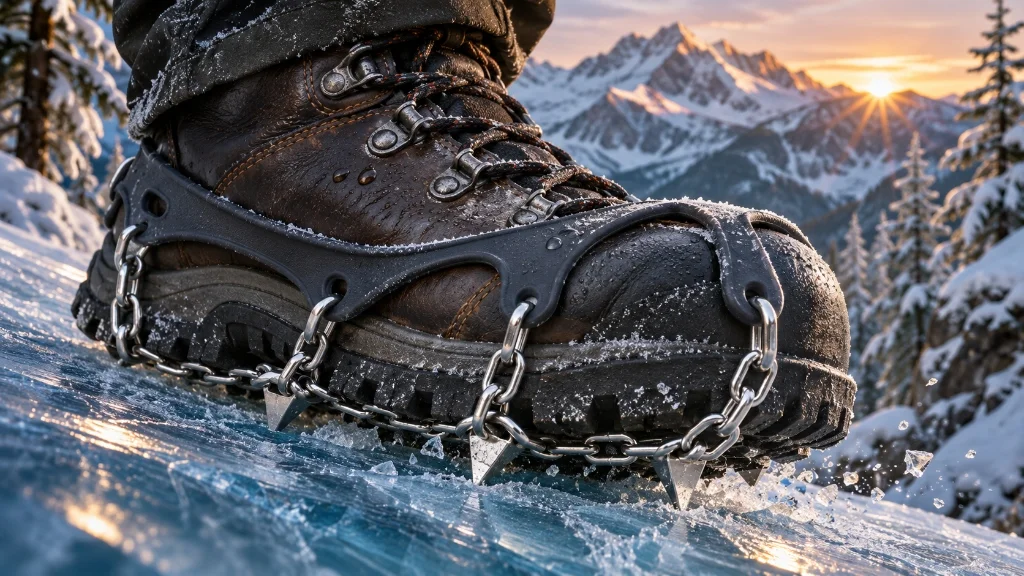
Microspikes are lightweight, highly packable slip-on devices designed to provide confidence on packed snow, frozen trails, and icy walking surfaces. They consist of a stretchy rubber-like elastomer band that stretches over your boot perimeter, connected to a web of small welded stainless steel chains underfoot. From each chain intersection hangs a short triangular tooth measuring approximately 3/8 of an inch.
- Primary Benefit: Extremely fast to put on and take off without unbuckling boots. You can hike in them naturally with an ordinary walking gait.
- Critical Limitation: Because the spikes are short (3/8 in) and flexible, they cannot anchor your foot into steep alpine slopes. If you attempt to traverse a 30-degree frozen snowfield in microspikes, your boot will shear sideways through the top layer of ice.
2. Trail Crampons: Extended Tooth Length & Top Strap Security
Trail crampons represent a hybrid evolution between casual microspikes and technical mountaineering crampons. Models like the Hillsound Trail Crampon feature substantially longer teeth (approximately 2/3-inch) mounted onto rigid or semi-hinged underfoot steel plates rather than loose chains.
- The Instep Strap Difference: Under lateral pressure on steep off-camber slopes, standard microspikes can roll around the edges of a boot sole. Trail crampons incorporate a wide nylon-and-velcro strap that buckles over the top of the instep, physically locking the elastomer harness in place and preventing rollover.
- Where They Excel: Rugged peak bagging in regions like the New York Adirondacks, New Hampshire White Mountains, or Pacific Northwest foothills where packed trails feature steep, slick rocky steps.
3. True Mountaineering Crampons: Rigid Alpine Armor
True mountaineering crampons are purpose-built for hard alpine ice, frozen couloirs, and glacier travel. They feature ten to twelve large, razor-sharp steel teeth measuring up to one full inch in length, including horizontal or vertical front points that extend past the boot toe.
- Front Pointing Mechanics: When ascending steep frozen snow or alpine ice walls above thirty degrees, hikers cannot place their feet flat. Mountaineering crampons allow you to kick your toe points directly into the slope, supporting your entire body weight on the rigid front teeth.
- Anti-Balling Plates (ABS): In warm winter conditions, moist snow can pack tightly between crampon points into an icy ball. Once this ball matches the height of the teeth, your spikes cannot touch the ice, leading to sudden slips. Dual-density ABS elastomer plates flex with every step, actively popping snow out before it can accumulate.
4. Snowshoes: Flotation Over Deep Untracked Powder
Spikes and crampons provide purchase on hard surfaces, but they provide zero flotation in fresh powder. If you step into two feet of uncompacted snow in boots and microspikes, you will immediately sink to your knees or hips—a physically exhausting phenomenon known as “post-holing.”
Snowshoes distribute your body weight across a large deck footprint (typically eight by twenty-two to thirty inches), keeping you on top of the snowpack. Modern technical snowshoes feature aggressive perimeter teeth and underfoot crampons, allowing you to traverse steep mountain ridges and climb vertical powder slopes without sliding backward.
Detailed Model Breakdown
Kahtoola MICROspikes Footwear Traction
Kahtoola invented the modern microspike category in Flagstaff, Arizona, and the Kahtoola MICROspikes system remains the benchmark against which all trail traction devices are judged. Built for durability, ease of use, and low pack weight, it is the essential winter safety accessory carried by day hikers, trail runners, and backpackers across North America.
- Spike Architecture: Twelve strategically distributed spikes made of durable 400-series heat-treated stainless steel, measuring 3/8-inch (1 cm) in length.
- Harness Technology: Thermoset elastomer band engineered with reinforced eyelets that remains elastic down to -22°F (-30°C).
- Flex System: Welded stainless steel chain links allow natural foot flex while walking, preventing stress fractures on metal points.
- Packability: Compresses into a compact included tote sack roughly the size of a standard grapefruit, weighing just 312 grams.
Pros:
- Intuitive slip-on design can be pulled on or taken off in seconds without removing winter gloves.
- Stainless steel construction eliminates rust concerns after hiking through wet slush and road salt.
- Extremely comfortable underfoot on packed snow, creating zero pressure points through standard hiking soles.
Cons:
- Ineffective on steep alpine inclines exceeding fifteen to twenty degrees where front teeth are required.
- Provides zero flotation when breaking trail through deep, unconsolidated powder snow.
Buyer reviews frequently highlight Kahtoola MICROspikes for incredible longevity, with many hikers reporting multiple seasons of dependable winter trail use without chain link failures or cracked rubber harnesses.
Hillsound Trail Crampon
For hikers who find standard microspikes too short for steep, icy northeastern trails or slick sub-alpine scrambles, the Hillsound Trail Crampon delivers the ideal upgrade. Designed in Vancouver, British Columbia, Hillsound engineered this device specifically for the wet, steep, and heavily iced trails of the Pacific Coast and Appalachian mountain ranges.
- Spike Caliper & Count: Eleven heat-treated carbon steel spikes measuring 2/3-inch (1.7 cm) in length.
- Hinged Plate System: Spikes are anchored to flexible, ergonomic steel baseplates that distribute pressure across the heel and ball of the foot.
- Retention Harness: Heavy-duty elastomer perimeter harness augmented by an adjustable velcro security strap across the top of the boot.
- Weight per Pair: 460 grams (16.2 oz) for size Medium, reflecting the thicker steel plate construction.
Pros:
- Longer 2/3-inch teeth provide deeper penetration into thick crust and frozen waterfall steps than standard microspikes.
- Over-the-instep velcro strap guarantees the harness will not shift or peel off during aggressive sidehill traverses.
- Underfoot plate architecture shields thin-soled footwear from spike pressure points during long descents.
Cons:
- Carbon steel spikes can develop surface oxidation if packed away wet without drying.
- Noticeably heavier and bulkier inside a winter daypack than ultralight microspikes.
Hikers who frequent steep winter trails commend the Hillsound Trail Crampon for providing confidence on steep icy switchbacks where shorter spikes begin to skid. Reviewers consistently praise the top velcro strap for keeping the device perfectly centered over boots.
Black Diamond Contact Strap Crampons
The Black Diamond Contact Strap is an authentic ten-point mountaineering crampon designed for winter hillwalkers, mountaineers, and ski tourers who encounter steep alpine terrain, frozen summit ridges, and hard glacial snowfields. Unlike technical ice climbing crampons that require rigid mountaineering boots with toe and heel welts, the Contact Strap features a universal flexible nylon harness that straps securely to standard leather backpacking boots.
- Point Geometry: Ten aggressive tempered stainless steel points, including two forward-facing horizontal front points for ascending steep slopes.
- Binding Architecture: Universal strap-on design with flexible toe and heel baskets made from cold-resistant elastomeric polymers and high-tensile nylon webbing.
- Anti-Balling Mechanism: Comes equipped with dual-density ABS anti-balling plates beneath both the forefoot and heel.
- Weight per Pair: 808 grams (28.5 oz), offering immense strength while resisting rust and dulling against mixed granite rock.
Pros:
- Provides genuine alpine holding power on hard blue ice and steep snow slopes up to forty degrees and beyond.
- Universal strap system mounts firmly onto non-welted three-season and winter backpacking boots.
- Dual-density ABS plates actively pop out wet snow, eliminating the danger of underfoot snow compaction.
Cons:
- Requires methodical fitting and strap tightening before hitting the trail to avoid loose webbing.
- Cannot be worn on low-elevation dirt, bare gravel, or paved trailhead sections without damaging teeth and joints.
Expedition hikers and alpine climbers praise the Black Diamond Contact Strap for rock-solid security during spring summit pushes and high-angle winter mountaineering routes. Users note that the stainless steel points maintain razor-sharp edges even after brushing against hidden granite.
MSR Lightning Ascent Snowshoes
When winter precipitation dumps fresh powder across backcountry forests, even the most aggressive crampons are useless against deep snowpack. The MSR Lightning Ascent is widely regarded as the ultimate technical mountain snowshoe, engineered to conquer deep powder, steep off-camber traverses, and rugged wilderness backcountry.
- Frame Architecture: 360-degree Traction frames laser-cut from high-strength aircraft aluminum, providing continuous bite along the entire perimeter.
- Flotation Decking: Lightweight, ultra-durable polyurethane-coated ballistic nylon fabric that resists puncture from sharp buried branches.
- Ascent Ergonomics: Integrated Ergo Televator heel-lift wire bar that flips up under the heel to reduce calf fatigue on steep uphill grades.
- Binding System: Freeze-resistant, glove-friendly Paragon mesh binding that conforms evenly around boots without creating painful pressure points.
Pros:
- Provides flotation across deep, uncompacted snowpack, eliminating the physical exhaustion of post-holing.
- Perimeter aluminum frame teeth deliver edge grip on steep sidehills where traditional round-tube snowshoes slip sideways.
- Televator heel lift bar makes long, steep mountain ascents feel like walking up a staircase.
Cons:
- Premium weight (approximately 1,850 grams per pair) that requires dedicated backpack carry straps when not in use.
- Excessive bulk on hard-packed, narrow trail corridors where microspikes are significantly faster.
Backcountry winter explorers and mountaineers applaud the MSR Lightning Ascent for its holding power on steep frozen terrain. User feedback consistently highlights the Paragon binding for never freezing up or slipping loose during full-day wilderness treks.
Winter Safety: How to Choose What to Pack
Experienced winter hikers follow the “rule of two” when heading into unpredictable mountain terrain:
- Always Pack Microspikes for Below-Treeline Hikes: Even if a trailhead appears completely dry, shaded gullies and north-facing forest loops frequently hide sheets of black ice. At roughly 300 grams, microspikes should live in your winter daypack from November through April.
- Carry Snowshoes When Recent Snowfall Exceeds Six Inches: If more than six to eight inches of fresh snow has fallen within the last forty-eight hours, snowshoes are mandatory to maintain forward pace and avoid exhausting post-holing.
- Upgrade to Crampons for Alpine Summits Above Treeline: Once you climb past the tree line onto wind-scoured ridges, snow turns into bulletproof hard crust or sheer ice. If the trail slope steepens beyond twenty degrees, swap your microspikes for crampons before you find yourself in an uncontrollable slide.
Who Should Buy What
To match the proper winter traction device to your planned routes and regional winter conditions, follow these guidelines:
- Choose Kahtoola MICROspikes if: You hike on popular, well-traveled winter trails, rolling forest paths, and frozen lakes with low-to-moderate inclines where fast slip-on convenience and low weight are top priorities.
- Choose Hillsound Trail Crampons if: You regularly hike steep, rocky mountain trails in regions like the Adirondacks or White Mountains, where thick ice steps require 2/3-inch teeth and an instep velcro security strap.
- Choose Black Diamond Contact Strap Crampons if: You tackle high-altitude winter peaks, glacier routes, and hard alpine snow slopes steeper than twenty-five degrees using standard non-welted hiking boots.
- Choose MSR Lightning Ascent Snowshoes if: You explore deep backcountry powder, break untracked winter trails, and need surface flotation combined with steep-angle climbing heel lifts.
For more cold-weather gear advice, explore our insulated winter hiking boots guide or check our heavy-load backpacking boots guide to complete your winter mountaineering footwear setup.